BREAKING NEWS
Showing posts with label paedophilia. Show all posts

Sunday, 20 January 2013

Chemical Castration and the Quest for 'Normalcy'

The Guardian magazine carried a rather interesting feature by Decca Aitkenhead yesterday, exploring the issue of chemical castration among sex offenders.  All those interviewed were men  -although they weren't all paedophiles.  It's fairly balanced and explores the issues surrounding chemical castration.  Rather like the piece, I don't have any firm conclusions as to the appropriate course of action in this area.  I do however think it's important to start by asking the 'right' question.

The Governor of Whatton does seem to be on the right tracks when she says:  "We're trying to stop the people we lock up from doing this again.  That's the key thing for me.  The majority of them will get out and will possibly be living next door to you or me.'

The logic of this position is therefore not 'what is the best form of retribution', but what dow e need to do, to ensure this individual is less likely to re-offend given they will be once again in our communities.    I'm not sure what the answer is, but that's surely the right question.

Check out the full piece here.

Thursday, 3 January 2013

Paedophilia as Sexuality?


Updated 15.28 on 3 January

Many thanks to @katesheill for alerting me to this story.  The Guardian carries a very interesting comment piece by Jon Henley in which he explores the disagreements amongst 'experts' about what causes paedophilia and whether it amounts to a 'sexuality'.  I'm not an expert on this aspect of sexuality but I confess to being open minded, and can see value in the arguments in favour and against it being a 'sexuality'.  The difficulty, is that this debate is so emotive and politicised that the arguments for/against become proxies for other sexual agendas rather than addressing the actual subject of inter-generational sex.

Henley himself makes a number of interesting observations about these debates from various experts, but he doesn't fully take account of the external forces at work upon these same experts.  A charity dealing with children has its own limitations, whilst academics - supposedly the most free of thinkers - are limited by institutional and Academy politics which condemn to silence whole rafts of opinion and thought.   That is perhaps the biggest change in recent decades, and perhaps explains the dramatic shift in 'attitudes' that Henley notes, and the contemporary challenges of viewing paedophilia through the lens of sexual liberation.

Henley does offer a definition of paedophilia, via the Sex offenders Act 1997, although an understanding of the complexities of this area might be better gleaned from the Sexual Offences Act 2003 - which also highlights the discrepancies in age when it comes to images rather than acts (you can consent to an act at 16, but an image only at 18).

For lawyers, the subject of consent is readily debated in other sensitive fields - notably the right the life (think abortion for example), and the recent right to life cases (for example Nicklinson and Pretty) and even in the context of age - the famous Gillick case of course.  Yet, consent in the context of sexual age is perhaps a taboo subject, touching as it so clearly does on the toxic subject of paedophilia.

The dominant rights-based discourse of the twenty first century is navigated by ascribing rights to 'children' (contrast with the nineteenth century) and those who are defined by sexualities - but not 'perversions' which remain taboo, and sometimes legally controlled and/or limited.  To define paedophilia as a sexuality would therefore shift the subject into a rights-based narrative, and thus one must face the liberal challenge of balancing rights, rather seeking to merely assert the rights of one group over another 'perverse' group.  Toxic stuff indeed.

Researching this area is surely a maze of funding difficulties, institutional politics and additional barriers  which one faces in the name of safeguards.  For example, a number of records of the now defunct Paedophile Information Exchange group (mentioned by Henley) can be viewed at the London School of Economics, but you must (or at least you did when I was using their archive for research on public sex a year or so ago) provide reasons for why you want to access those files which are then put on record.  My idle curiosity at looking at the files as someone who teaches law and sexuality was stopped dead in their tracks.  That's not a database I'd like my name anywhere near - especially when you consider the bungled Police operation that was Operation Ore, and the history of data becoming misconstrued.

Please don't misunderstand me, I am not suggesting that the current collective (if there is one) view of paedophilia (as variously understood) is wrong.  I am however, questioning the absence of a debate when we debate so clearly every other aspect of our existence.

The Henley article is therefore a really interesting insight into some of the arguments in this area, but those seeking a deep and open debate in this area must continue to wait.

UPDATE:

Thanks to @PauldeMello_jnr who alerts me to the Telegraph piece by Damian Thompson responding to the Guardian article.  It does rather underline my comments.

Thursday, 16 February 2012

The Sex(y) Boy and Treasure Island Media

The controversial TIM poster
If you consider yourself the most controversial bareback porn company in the world, how to stay in the news?  How do you remain 'controversial'?  In practical terms this arguably means being ever more outrageous, more shocking and more scandalous.  A remorseless engine of filth and depravity.  Yet, rather like Jaws: The Revenge, there comes a point when things just don't work anymore.  It's a sequel too far.

I'm not sure we're there with Treasure Island Media (TIM) yet - they are a loved brand which continues to operate in the counter-cultural space of bareback sex - but the pressure is undoubtedly there to keep being controversial.

Yet, any such pressure could be ephemeral or indeed, misguided.  As long as legislators and judges keep seeking to use law as a tool to limit, and potentially criminalise bareback sex, TIM will be able to claim the role as counter-cultural icons.  Given the widespread practising of bareback sex within same-sex encounters, they are also able to be 'popular' counter-cultural icons.  A double win.

Moreover, simply being there and being the celebrated stuff of masturbatory sessions across the globe is not, and has never been enough for TIM (NSFW).  I was therefore fascinated to see them seek to associate themselves with another taboo act in recent weeks.  The taboo of taboos.  The big daddy of controversy.  Yes, inter-generation sex.

Legally defined typically as paedophilia when involving children, inter-generational sex remains the social horror of our time.  To label someone as a paedophile is to pronounce them socially and potentially physically dead.  They are transformed into the ultimate evil within society.  Our understanding of paedophilia is increasingly nebulous, encompassing someone who accidentally downloads a paedophile image alongside another who rapes a child.  Whilst we can accept that someone might want to watch The Sopranos and not seek to become a mob boss, Weeds and become a (fairly useless) drug dealer with cute kids or Hung and seek to become a wooden (in every sense) male escort, or indeed, even if we aspire to any of these things, we won't actually do it; we can not contemplate even curiosity around the image of someone under 18 years old.  This is is despite English law finding is acceptable to sleep with someone aged above 16 (shag 'em, just don't take a picture).  It is indeed a curious socio-legal landscape.

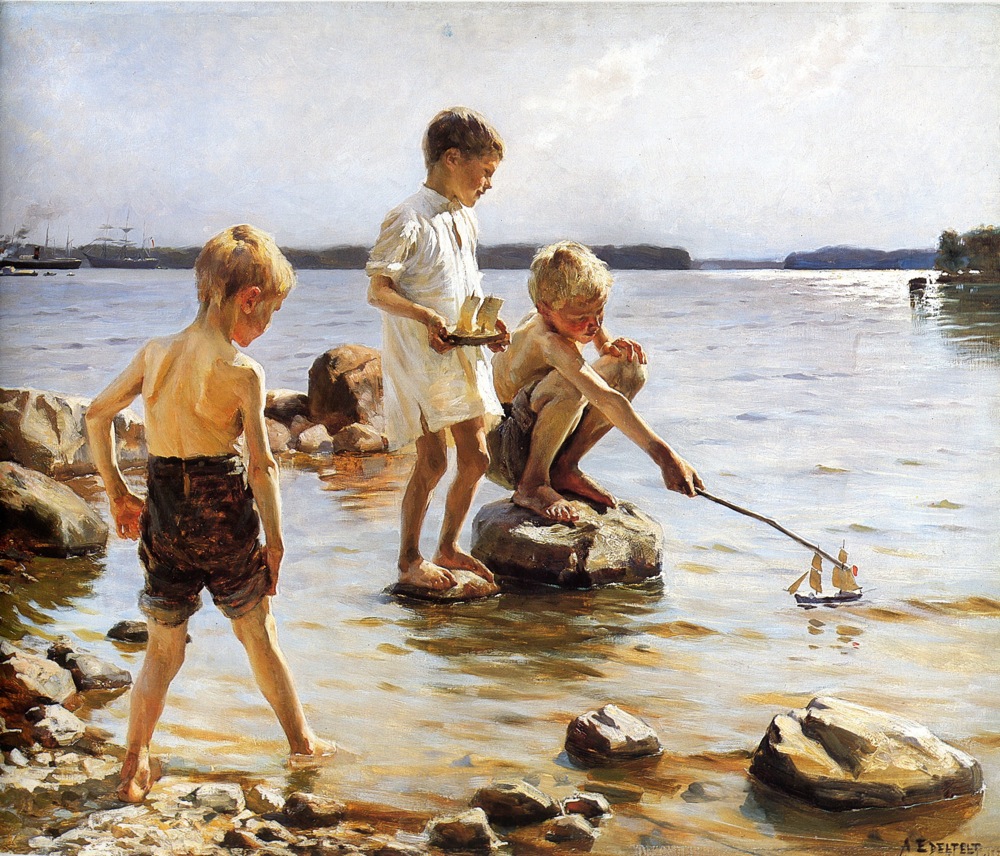
The original Edelfelt painting
Yet, despite this, I've been struck by the way in which social media - notable Twitter most recently - has enabled those aged below 18 and indeed, below 16 to express their sexual desires, arrange hook-ups and document their sexual encounters.  Similarly, uncertainty and fears are sometimes expressed.  In short, human beings and their complex sexual awakenings are laid bare.

Into this fascinating cultural maelstrom enters TIM, apparently deliberately seeking to play with the issue of age.

At the start of the month, TIM uploaded a poster on their social media sites promoting a new film release entitled Return to Meat Rack (it's a sequel but hopefully better than Jaws IV).  It depicted two boys playing with boats on a lake or by the sea.  The young boys and the composition evokes innocence, a deliberate counter-point to the function of the poster - promoting a film about men fucking.  To date, the postings on Facebook have resulted in 76 comments from TIM followers and fans with a mix of reactions but many are negative, suggesting that TIM have gone 'too far'.

It's through these comments however that we learn (thanks to one culture vulture fan) that the picture is in fact from Albert Edelfelt and a quick Googling reveals the picture to be dated from around 1885, an oil on canvas production and entitled 'Boys playing on the beach' (Leikkiviä poikia rannalla).  Interestingly, there is a third boy in the original picture (see above) who is edited out of the TIM composition.

An earlier TIM poster depicting a 'child'
None of this is entirely new however. TIM previously published rejected posters from years gone by including one allegedly of a young (rather affluent looking) Paul Morris, aged 8 on a scooter (pictured right).  The slogan - which apparently deliberately evokes inter-generational behaviour - states 'A Better World One Boy at a Time'.  Boy is one of those words that can be taken to mean a male child but which is also used extensively - especially in 'gay' circles - to denote a young male - typically twinkish looking which is to say slim, smooth, well errr, boyish.  A twinkly boy is OK to lust after, whilst a real one isn't.

All of which are broad points I've made before but it is TIM utilising the idea of age and hidden desire as a marketing tool which is fascinating and new.

They apparently believe - and I think they are right - that just as homosexuality, then bareback sex were desires which have had complex social and legal relationships, so too is inter-generational sex.  Put simply, they think that gay men probably quite like boys more than we'd care to admit.  Such is the history of claims that homosexuals were out to 'take your children' that once again a silence is imposed for social and political reasons within the gay community - and the point I accept at the start of this paragraph will be toxic for many.

Jackson Taylor
Yet, leaving that aside, there is the less radical, but perhaps no less controversial idea that children can be sexual beings.  This is the revelation that social media already offers to anyone willing to see it, and raising difficult social and legal questions about consent and contemporary domesticity.

Morris has a Flickr page (NSFW) where he uploads some wonderful images freely available to all those who pass through an age barrier.  What always makes these photos so engaging - at least for me - is the use of captioning.  This allow the viewer to be located in the moment and somehow lends greater power to the image.  Much as when we look at a photo we have taken or were present for, we add an inward dimension to the image - context and emotion  - so too, do these captions add something.  His latest model obsession  -and potentially hit - for the studio is a twenty year old man/boy called Jackson Taylor (pictured left).  Morris has uploaded several pictures of Jackson and he comments under one image: 'I said "I'm thinking of signing you on. What do you think?" He responded "If you get me fucked all the time, I'll sign the contract in blood." If you saw him at the next table in a restaurant you'd think he was the picture of innocence and naivete. But this boy is one of the most voracious sexual predators I've ever met. We signed the contract before he'd even put his clothes back on.'

In this and a number of other comments, Jackson is anchored as a sexual being of today. Seeing Jackson getting fucked in Manfuck Manifesto (see more here, possibly NSFW) viewers of TIM pornography are left in no doubt about that sexual status.  Yet, we also have Morris posting on his photos (under the Jackson image reproduced above) the following fascinating text: 'I asked "How old were you when you started fucking?" He said "I was four. I seduced the 12-year-old twins who lived next door." I responded "Precocious--if it's true." He looked at me like this and said "Believe it or not, but it's true." He's 19 and has an understanding of sex that's truly rare.'

So now Jackson is a sexual being since four, and moreover, a sexual predator since four.  There is no question that he is the abused, or the 'victim'.  Defining him as the predator, and Jackson using the term predator - to denote an encounter with older boys - locate him as the individual with power.

This photo on Morris' Flickr page was uploaded on February 12th but it wouldn't have been a total surprise to TIM fans who might have noticed this post (NSFW) on TIM's Island website (this evolved out of their blog) which appeared on February 8th.  It introduces us to Jackson and his story.  It states:
Born in rural Sicily a scant 19 years ago, JACKSON TAYLOR (born Giuseppe Bontade) began his career as a primo fuckisto at the tender age of four. “I knew what I wanted to do from very early on,” says Mr. TAYLOR. “Our neighbors in Sicily had a pair of twins—they were 12. They gave me my first experience, my prima apertura, my grand opening. The affair lasted nearly a year.” Forced to flee their native village by irate clergy and outraged villagers, Mr. TAYLOR’s family took their precocious son to America, land of the free and willing. “Once we reached the Land of Opportunity, it’s pretty much been a straight-up path to Treasure Island Media for me. Of course it’s been my lifelong dream.” When Mr. TAYLOR approached T.I.M., the welcome was warm. “I know genius when I fuck it,” quipped porn legend PAUL MORRIS. “This boy may be slight of stature, but his bunghole can take anything we give it.” When asked about future dreams, Mr. TAYLOR wrinkled his boyish nose, shrugged coquettishly and said, “I dunno… Donkeys and dogs, maybe! And I like cheerleading.” JACKSON seems to be on a mission to take every load in America. We’re not wasting any time helping him! Watch him getting plowed by Ethan Wolfe in his TIM premiere, MANFUCK MANIFESTO.
So, here we have the 12 year old twins again (yes, incest is subtly hinted at too) and then we move into a blurb that seems to have been written by someone who has spent too long watching bad daytime soaps.  It's hard not to raise an eyebrow or a chuckle at the 'forced to flee' section.  This does of course also serve to cast doubt over the whole story but true or otherwise, TIM are making use of it and as with so many things that TIM do, truth as a fixed permanent concept must be abandoned in favour of a postmodern framework.  In the final section of the Jackson blurb we move into the positioning of Jackson as boyish, with innocence deployed to denote youth.  A sex(y) boy clearly and, his media persona suggests, a slutty one at that.

TIM started 2011 with a determination to push HIV positive porn and that - to my surprise - didn't work out.  This year, they are not stating they re trying to push a new area of controversy but there can be little doubt that like the boys in the Edelfelt picture, they are dipping their toes in the water.  This is one to watch with implications well beyond the world of bareback porn.

Sunday, 8 January 2012

Child-on-Child Sex Abuse

ABC News features a fascinating AP report on the subject of child-on-child sex abuse.  It's quite a detailed story with some fascinating academic and research insights, highlighting the complexities of this issue.  Whilst society arguably has a clear idea of the 'pedophile' and 'child abuser', cases of child-on-child abuse  disrupt these pre-conceptions, and challenge that totemic concept: childhood innocence.

Read the full story here.

Tuesday, 3 January 2012

Child Sex Offender Disclosure (CSOD) Scheme in Operation

It's easy to forget about a story once it's dropped out of the headlines.  The introduction of 'Sarah's Law' (like Megan's Law in the USA) enables parents to seek disclosures on whether their new partner has a record of sex offending.  The theory is to make homes safer for children.

One regional newspaper highlighted this week that 53 people in Lancashire made applications about someone their child has close contact with under the Child Sex Offender Disclosure (CSOD) scheme since it came into force on April 1.  The information was provided under the Freedom of Information Act and it will be interesting to see whether they are representative of the national uptake, and whether over say three years, the figures reflect an initial 'surge' of demand or an ongoing level of demand for information.

What it does show is that the scheme is up and running and potentially making an impact on hundreds of families around the country.

Read the full story here.

Saturday, 31 December 2011

Truth, Crime and the Hunt for Paedophiles

The Times carries a fascinating piece today revealing that lie detector tests are being used to help to decide whether to charge suspected criminals for the first time in British policing history.  The Times makes clear elsewhere that whilst the tests are 'reliable', they are not 'perfect'.  Check out the Independent take on the story if you don't have access to The Times.

A pilot was conducted by Herefordshire Police who tested 25 'low level' sex offenders.  According to The Times, 'many were exposed as being a higher risk to children than originally thought. A further 12-month trial has been approved to begin in April.'

A separate piece provides detailed exploration of the pilot through a case analysis of 'Michael'.   He was arrested on suspicion of loitering outside a school and following pupils in his car.  Acts which - the Police would surely argue - suggest the intention to commit an offence with those children.  A predator stalking his prey.  Michael denied the allegations but he did admit that he had accessed indecent images over two years and had used search engines to look for young girls.  However, he insisted he had no physical sexual interest in children.

Michael was, it seems, making a distinction between 'desire' and action, between possessing a fantasy and acting upon it.  Law traditionally focuses upon action rather than desire in sexual offences but paedophilia is something of a peculiarity for English criminal law.  For example, the law accepts a sixteen year old can have sex with a forty-nine year old.  Socially, it might be looked upon with disdain but it is legally tolerated.  However, if that 49yo takes a photograph on his phone or a makes a video of the encounter for subsequent sexual succour he has (thanks to the Coroners and Justice Act 2009) become a paedophile.  Ta-dah!  In the curious scenario, the 'desire' is condemned more than the actual consensual act.  Go figure.

In the case of Michael, Detectives found 'low-level' images in his bedroom but a search of his computer and other storage media did not turn up anything on top of admissions that Michael, 56, had already made.  So, the Police strapped him to a polygraph in a bid to obtain further answers.  Arguably, the investigation would have ended there without the polygraph - although it's not entirely clear. Michael disclosed for the first time that he had communicated with children online for a sexual purpose. He said that he had seen young girls on webcam sites, and had asked them to perform sexual acts while he watched. Michael issued denials to a series of questions including whether he had engaged in physical sexual contact with children and whether he had tried to arrange a meeting with someone younger for a sexual purpose. He also denied taking any images of children for a sexual purpose or distributing indecent images of children. The polygraph detected strong deception in his answers to all of those questions. Consequently, Michael was deemed to be a higher risk than first thought and the investigation into his activities was prioritised. He was removed from the polygraph testing trial as it is for low-level offenders only.

What does this mean?  Michael's been deemed a higher risk in the absence of evidence and 'risk' is not an offence per se (although presumably from the material they found, they had enough to charge him anyway).  What subsequently happened to Michael is unknown insofar as it is not explained in the piece.

There is an assumption that having been regarded as a 'higher risk', he will - at the very least - be monitored more closely than he might otherwise be, but quite where that mandate comes from legally is questionable.  Even if one sets that aside, there is an assumption that resources for these support mechanisms are adequate when we know they're not.  Voluntary groups are few and far between as the general public are far more likely to dip their hand in their pocket to support another charity rescuing cuddly animals in a far away land than providing support mechanisms to support paedophiles in their community.  Vital groups such as Circles UK need more support, but volunteers are unlikely to be able to 'admit' to being involved to many employers for fear of raising eyebrows and questions about their own motivations.  It is impressive and encouraging that they do indeed attract volunteers enabling their vital work to continue.

So, we assume - wrongly - that Michael might now get further 'support' or 'monitoring' dependent upon your linguistic spin.

The broader point is, as I touched upon above, the issue of desire.  An attraction to children is a social and legal taboo.  Within gay culture, an attraction towards youth - and attributes we associate with it - smooth hairless bodies, androgynous bodies, smooth faces, boyish smiles, and 'fun' personalities come together in the twink identity.  A label celebrated within gay culture and pornography, and an identity to be found in many a gay club and bar this evening as towns and cities celebrate NYE.   Desiring these figures is acceptable.  Even the more muscular twink can be a symbol of acceptable attraction.  The diver Tom Daley is unusual in being a child that many gay men could openly admit to finding sexually arousing and not feel condemned as a paedophile.  A fascinating development in itself.

Upon turning 16, even more men appeared to admit to a 'long-standing' attraction - which suggests attraction whilst still a child.  At 17, those fantasying men -assuming Daley is mutually attracted - could now have legal sex with Daley.  However, should Daley be photographed in less than his famously figure hugging trunks, his photographer would be in a spot of bother.  Expect a greater outpouring of Daley adoration during the Olympics next year (Daley will have just turned 18 so nude shots will be OK should he have a trunk malfunction at the Olympics).

In the case of Michael, it is this reluctant admittance of desire that seems to have landed him deeper in the crapola than he might have otherwise found himself.   The argument about child pornography is that it is a 'record' of a child being abused and thus to share that image is to create a market and encourage further abuse of children.  Thus if you wish to stop the market, you should stop the images.  You are therefore vicariously abusing a child.

Yet what of pseudo-photographs or cartoons? Bits of multiple images joined together to create a new sexual image, or using a computer or animation technology to create a pornographic image? Legally, this too is treated in the same way as a photograph.  Why?  The market argument is phony in these circumstances.  It is instead about the policing of desire.  From mental desire, to looking at an image is a step, a step to re-enforcing a mental pathway of desire.  Neurons making the connection between images of youth and sexual arousal. The forging of these pathways of desire is of itself a social concern within our society.

However, our criminalisation of such desire - nobody is being harmed - is on the basis that desire is an indicator of potential future risk.  It's like suggesting that viewing a knife-block in Argos denotes you as a future knife armed murderer.

The continued introduction of these polygraphs therefore is about a significant extension in the policing of desire.  Our society can not regard paedophiles as anything other than universally bad - despite our occasional admittance of widespread youthful desire, as in the case of Tom Daley - and thus the criminalisation of this desire is a logical extension that can not be argued without raised eyebrows and agendas questioned.  If a government proposed the mandatory badge wearing by convicted paedophiles would it be opposed?  If gas chambers for paedophiles were advocated, would they be opposed?

These are of course emotive and extreme examples but they serve to highlight the dangers of the road we are on.  In criminalising desire we make black and white assumptions about our own desires; are we really that sure of our own purity?

Thursday, 1 December 2011

Beware the Pedobear!

Pedobear, Pedobear, does whatever a Pedobear does...as Homer Simpson didn't quite sing.

Some of you might remember a Brass Eye Paedophile special from a few years back in which they satirised the way the media and politicians were treating the subject of paedophilia.  Readers in the UK can watch that episode via 4OD (check it out here).  Even Chris Morris and Brass Eye couldn't make up a story that appears on the Huffington Post today surrounding the latest twist in the 'Pedobear' saga.

This is a cartoon bear originally intended as a joke on paedophiles, acting as a (strangely cute) representation of a paedophile.  However, the image apparently then became re-owned by paedophiles as a symbol of pride.  However - and you couldn't make this up - the New Mexico Attorney General's Office is now investigating following a surge in sightings of bear depictions on vehicles.  They apparently fear - don't laugh at the back - that this may suggest an increase in sex offender behaviour in the Albuquerque area.  Fascinating and bonkers in equal measure.  Check out the full story here.  The HuffPo piece helpfully points out that 'It is not illegal for people to display the Pedobear image in public.'  Well if it was, there would be an amazing first amendment case to bring.  It could finish poor Justice Scalia off!

The piece also explains that 'Some people may be displaying them as a joke, but the attorney general's office said they are taking the bear images seriously and are trying to get the word out.'  Look out for them in Halfords!

Monday, 10 October 2011

A BoyLover's Glossary

One of the interesting aspects of my law and sexuality class (there are of course, many) is the use of language.  Every new cohort is a reminder of the importance of language around sexuality and the specialist terms and subtleties of use associated with words.  Take the 'twink'; the smooth slim youthful sugary gay male or alternatively the 'bear'; the hairy, large build, 'masculine' gay identity.  Cottaging, dogging, BDSM, kink, frottage, rimming, and so on are examples of the terms that every year need some degree of explanation.  The growth of the Internet has meant that we have a whole level of new 'words' and terms, and boy love - intergenerational male for male sex is no exception.

Sometimes defined as paedophilia (although an imprecise term) this site - A BoyLover's Glossary - documents the language that is used within this network - and is clearly intended for self-identified boy lovers.  So we get the familiar LOL but we also see TBL for teen boy lover or  PVF for plain vanilla faggot (someone who is not a boy lover - a 'plain' gay).   You can view the site in full here.

It is essentially a net speak glossary of boy love and links to a couple of 'pro boy love sites' so it's fairly clear to see the angle the site designer is coming from.  There's nothing explicit or shocking on the site although I'm sure the terms will seem uncomfortable for some.  Nonetheless, in an area that concerns so many, but for which the light is rarely shone, this site is an important information resource.

Wednesday, 24 August 2011

Internet Control, Censorship and Child Safety: New Parliamentary Inquiry Launched

I've just posted news and initial thoughts on a new Parliamentary Inquiry into online child safety on the new IT Law Node blog I've been setting up. Check it out here.

Sunday, 21 August 2011

Sex Offenders: The Last Pariahs

The New York Times caries a really interesting op-ed piece today from Roger Lancaster on US sex offender laws. It's a powerful and engaging article, with a conclusion that will upset many:
Our sex offender laws are expansive, costly and ineffective — guided by panic, not reason. It is time to change the conversation: to promote child welfare based on sound data rather than statistically anomalous horror stories, and in some cases to revisit outdated laws that do little to protect children.
This reflects Lancaster's thinking in his book, Sex Panic and the Punitive State and he is one of few academics brave enough to make these remarks in print (I've met many academics who agree with this position, they just don't want anything written down). Given the UK has attempted to import ideas such as Megan's Law (Sarah's Law here), the ideas/critique offered in this piece are also applicable to English law and the English criminal justice system. The article once again underlines the need for an informed and reasoned discussion in an area too often, if understandably so, characterised by panic, fear and emotion.

Thursday, 11 August 2011

A Memo From History

I spent the first part of this week down in London at the National Archives. I made some interesting discoveries but because I want to save them for publication, you'll forgive me if I don't publish them on here. I did however come across one memo to the Wolfenden Committee in 1955. Wolfenden was the committee that reccomended to the government in 1957 that homosexuality should be decriminalsied - and this was to herald the eventual decriminalisation of homosexuality in Engladn and Wales through the Sexual offences Act 1967.

Anyway, this memo was written to the committee, the identity known the Chairman but hidden from the official 'evidence' document. The reason? The man providing evidence was a homosexual and thus given the moral and legal condemnation of his disposition, he remained anonymous for the purposes of this document. Here's an extract:
‘What possible good can a prison sentence do? Fear of it will not stop a fundamental biological activity like sex. As it has not stopped it thus far, it presumably will not do so in future. Again imagine the opposite, i.e a law passed by homosexuals to make heterosexual relations illegal. Would it stop it? It would, if course, only drive it underground, as the law has at present driven homosexuality. It certainly helps to fill the overcrowded prisons at the tax payers expense.’
Replace the word 'homosexual' with 'paedophile' and it's quite a scary passage. No, I've not suddenly turned into a paedophile rights campaigner but I do recognise the law has thus far not found a satisfactory response to paedophilia. The above extract - albeit about homosexuality - serves as a powerful reminder as to why the law is having a real problem addressing this phenomenon. Sex is about desire, and a biological desire. Can one ever stop such a desire?

Tuesday, 5 July 2011

Rebekah Brooks and Fitness to Lead

The phone hacking story is gathering momentum and events will no doubt have moved on in the brief time I sit and write this post. What's curious from the point of view of this blog is the way that Rebekah Brooks has sought to defend herself today. She's been silent (thus far) on the airwaves but did release a written statement which you can read in full here.

About three-quarters of the way through her statement, she seeks to define her tenure at News of the World in the following terms:

'I hope that you all realise it is inconceivable that I knew or worse, sanctioned these appalling allegations.

I am proud of the many successful newspaper campaigns at the Sun and the News of the World under my editorship.

In particular, the 10-year fight for Sarah's Law is especially personal to me.

The battle for better protection of children from paedophiles and better rights for the families and the victims of these crimes defined my editorships.'

I heard this with disbelief. During the period that Wade refers to, News of the World shamelessly fuelled a moral panic around paedophilia and inter-generational sex in the name of profits. Together with other tabloid papers (notably fellow Murdoch paper, The Sun - and which she also went on to edit) it sought to dominate the media with endless scare-mongering. It has been widely accepted to have linked to one incident in which vigilantes attacked the home of a hospital paediatrician after apparently confusing her professional title with the word 'paedophile'. Remind yourself of that story here.

That moral panic has continued to frame the debate around paedophilia, limiting policy development and hampering intellectual and academic exploration of the complex issues in this area. Few academics are brave to talk about this issue, and fewer still are willing to challenge accepted wisdom in the field thanks to campaigns such as the one run by Brooks and the News of the World. Such was the extreme nature of these fear feeding frenzies that Brass Eye satirised the media's treatment of this issue in 2001 - see that here.

That doesn't sound like something I'd want to highlight as my finest hour, or to define me as the sort of person I am. In fact, it seems to suggest someone who would exploit vulnerable people for their own profitable cause. Whether that applies explicitly to Brooks is for others to decide but her defence today, I would suggest, raises fresh questions about the ethics of media leaders.

What is clear however, is that it is a shameless mischaracterisation of history to now define that period of journalism as anything other than the shameless fuelling of a moral panic for commercial gain.

Monday, 30 May 2011

The Youthful Dilemma

The other day I posted a piece about the Brisbane Supreme Court and a 12-year-old who had posed as an 18-year-old. Another aspect of the age debate is the appearance of youth. At the recent Erotic Awards 2011, the 20-year-old sex worker, Josh Brandon won the 'sex worker male' category. I'd exchanged a few tweets with him before the awards and he seems a really nice guy. What I write next, should not in any way be seen as a criticism of him.

On the right of this post, I've posted a photograph of Brandon, taken from his escort website. Lower down this post, you can see a photo of Brandon clutching his golden penis from the Erotic Awards. When you look at the first photo, what do you think?

Well, Brandon prompts you on his site
, writing: 'I have a slim 25" waist, tight little butt & shoulder length blonde hair; my looks are very young, younger than 19, 18 and probably even 17'.

He is making a sales pitch of not only his youth, but his underage look. He could, it seems to me, pass as a convincing 14 year old based on these photos. He's also, he states,a highly successful sex worker, and one for whom sex work has empowered, he writes:

'With me you will meet an escort who enjoys his job and the freedom it gives me to travel and to meet lots of interesting people and the comfortable lifestyle I live are reasons I love this work. You will be in company of a boy who appreciates and respects his clients with professionalism. I like people, I like to travel and meet people from different cultures and backgrounds and I appreciate my clients who respect that a profession is what this is.'

His quoted rates, support his high-demand status:
GREAT BRITAIN

In call Out call

1 Hour - £160 £200
2 Hours - £280 £320
3 Hours - £400 £440

Overnight - £800 £900
Weekend - £1500 £1500
One Week - £3000

USA
One Week - $5000
Weekend - $2500

Europe

One Week - €3500
Weekend - €1750
Overnight - €1150

Our legal culture penalises those who have sex with someone underage but also prosecutes those who have possession of child pornography - including pseudo-images. We are however, comfortable (at least legally) with images that look like child pornography but which are not (assuming it can be proven). For Josh Brandon, who trades upon his youthful appearance, we have someone who is quite possibly satisfying the sexual desire of those men who wish to have sex with someone underage. In doing so, is he -as the argument about child pornography goes - 'fuelling' desire, unwittingly increasing the chance of someone going out and committing an offence.
I'm not a psychology expert so I don't know. Is he alternatively, satisfying a sexual desire and thus reducing the chance of possible offences, and also enabling men who were unlikely to offend, to reach a state of sexual pleasure and satisfaction they would not otherwise legal be able to obtain?

More generally, queer culture celebrates the youthful twink in pornography and as sex workers. We like cute hairless 'boys', so long as they are legal. Yet, as much as this forms an acceptable part of the gay lifestyle, it also harks back to a time when NAMBLA could appear at gay pride events, and when gay men were seen as universally paedophiles. In seeking legal acceptance, homosexuality has carefully re-positioned itself away from controversial issues around 'youth'. The one notable exception, Peter Tatchell, who has advocated an age of consent of 14 is on the margins of the gay establishment, and a firm outsider from wider policy formation.

This isn't just a 'queer' or 'gay' issue. Just look at the vast quantities of 'school girl' porn available for straight men, where adult women dress as school-girls and lick seductively on a predictably red, lollipop. Think of the various student nights in which people dress in school uniforms but couple it with a strongly sexualised image.

So, are we comfortable with gay men performing the fantasy of paedophilia (which they may or may not do with Josh), whilst also extending the child pornography ban to 'pseudo-images', and cartoons?

At this point, let's turn to the Coroners and Justice Act 2009.

Section65(6) states:

Where an image shows a person the image is to be treated as an image of a child if—

(a)the impression conveyed by the image is that the person shown is a child, or

(b)the predominant impression conveyed is that the person shown is a child despite the fact that some of the physical characteristics shown are not those of a child.

(7)References to an image of a person include references to an image of an imaginary person.

(8)References to an image of a child include references to an image of an imaginary child.

So, here fantasy is attacked as far as the 'image' is concerned. It needn't be real or realistic. A cartoon of a 10 year old with a 20 inch penis is child pornography, as is a photograph of a real 10 year old being abused by a real person. That legislative approach seems wrong to me, but what of fantasy acts? If the law is as pre-occupied with fantasy as it is reality, what of the Josh Brandon sex workers and his fellow twinky performers? Something to ponder.

Sunday, 29 May 2011

Child Sexuality and the Limits of Consent

I came across this story the other week, and I've been mulling it over since, debating whether to post a link, and if I did, what comment, if any, to add.

The story refers to a case before the Brisbane Supreme Court, in which it was revealed that a 12-year-old boy - posing as an 18-year-old homosexual man - actively pursued and engaged in sexual encounters with a man he met via an Internet dating service. He'd used a 'mainstream' dating service called Oasis Active to set up the site.

The court was told that over the space of three months, the boy would sneak out his family home, in Brisbane's east, late at night and slip down the street to a nearby golf course to meet his online liaison who was at that time a 30-year-old lifesaving fundraiser.

The boy indicated that when he met males online - including Powell who went by the nickname "Johnny" - he would inform them he was 13-years-old, a year older than he actually was.

Recovered Internet chats found on Powell's laptop computer reveal he discussed having a weekend "sleepover" with the boy, a possible "threesome" with "another "guy".

They also included a request from the child that "this time your going to (expletive deleted) me."

During another online chat Powell asked the boy why he was at home on his computer during a school day.

"When the child responded that he was pretending to be sick and was home alone all day, he (Powell) suggested: 'Maybe I should come over'," the schedule says.

"When the child advised that another guy was coming over they discussed a possible threesome."

Read the full story here. I've tried in vane to find other reports or any court transcripts/judgment but if anyone does have such links, please post them as a comment.

So, here's a few thoughts/questions:

  • Would our reaction be the same if rather than being 30, the convicted male had been 18? If so, why?
  • Had the boy not revealed he was 13 subsequently (which was also a lie), and insisted he was 18 all along, would we react the same way?
  • Had the boy posted a picture on his profile in which he appeared older than he was, would we take that into account in reaching a moral (as distinct from legal) view?

The killer question, can a 12 year old consent? Legally, no he can not. We can not make a judgment on these small exerts in a news story, but all the quotes from the child suggest a boy who is sexually aware, knows exactly what he doing, and is so determined to have homosexual sex with a male that he will lie to achieve that goal. In certain circumstances, the law accepts a child can consent. Has this child reached that level of consciousness?

Even if he has reached that level, is that outweighed by the obligation of an adult to refuse that boy's request? Yet, is that refusal based on the assumption of a harm being inflicted upon the boy? Should we simply encourage the boy to find a sexual act with someone nearer his age if sexual experimentation is what he's determined upon? If so, is it the age difference rather than a 12 year old having sex per se that concerns us? Ahh yes, age difference. If it is age difference, then it's not about consent at all, it's about something else. So, what exactly is and should be the guiding influence for law and the state in such cases.

I don't have the answers, just a whole bunch of questions.

Monday, 28 March 2011

Sexting Youths

The New York Times carried a fascinating piece at the weekend exploring the challenge that 'sexting' is increasingly posing for US states. Sexting, is where a nude (pornographic) picture of oneself might be sent to someone else over a mobile network. Accoridng to the NY Times, some states have amended their statutes on child pornography, obscenity or Internet crimes. Many allow juvenile offenders to be charged with a misdemeanor or a lesser offense, so they can qualify for diversion programs and have their records expunged. A few states have tried to define a sexting offense. The NY Times also did some interviews with teenagers which you can read here.

It's a nightmare for English lawmakers too, challenging our simplistic notions of who is and who isn't a paedophile. It's perfectly legal for a 16 year old to consent to sexual activity under English law, but if they take a pornographic photograph of themselves, that amounts to child pornography - and such images can easily be circulated beyond their originally intended audience.

Although this story focuses upon 'sexting', it's worth also bearing in mind the growing role that Twitter can potentially have for the distribution of these images - encouraging as it does rapidly evolving networks. I don't have the solution but I do know it means the legal notion of what a paedophile is, and what wider society understands by that term, is increasingly disconnected.

Wednesday, 16 March 2011

Operation Rescue and the Boy Lover Bust

Thanks to @LawFag for making me aware of this story a few moments ago. The BBC are reporting that Police from around the world say they have broken up the largest Internet paedophile ring yet discovered. According to the report, detectives say 170 people have so far been arrested - and 121 of them were in the UK. Clearly, more arrests are to follow. Some 60 children have been 'protected' in the UK. Interestingly, the report indicates that the whole operation has been based on infiltrating one online site/network. The members of the network apparently went into a private channel, boylover.net, and then used its secret systems to share films and images. The Police were present within these networks and posed as paedophiles to gather intelligence.

The vast spread of ages amongst paedophiles is once again demonstrated with the revelation that in the UK, the 240 suspects are aged between 17 and 82 years old. They include police officers, youth leaders and teachers. No indication is given of gender, but it would be reasonable to assume the majority will be men.

I remarked on Twitter that I know a number of academics who want to question the current policy and policing approach but daren't for fear of being labelled as themselves possessing some 'abnormal' tendencies. I've always steered clear of this area of research but I do find it worthy of comment to observe that the police were active in the network. It will be interesting to see the extent to which the police actively encouraged the sharing of information and photography over this network. Did the Police themselves engage in acts of image distribution and reproduction in order to entice the suspects into exchanging information and images? This is a real sticky wicket for law but such nuances are lost on the public and the media. Consequently, such arguments are unlikely to get very far in a court-room.

Censored transcripts have been published in the US of some investigations. It would be interesting to see similar transcripts of this investigation. Similarly, I'm struck by the high-number of children that seem to have been, in the language of the police 'rescued'. This suggests a far closer linkage between image sharing and 'real-world' criminal activity than is ordinarily assumed. A final aspect that shines out, is the use of 'boylover'. In America thanks to the long-established North American Man-Boy Love Association (NAMBLA), the term 'boy lover' is much more established in the public consciousness and associated with paedophilia. This is (I think) the first time the term has been used in such a high profile way within the British media. it will be interesting to see the long-standing effect that has.

Clearly, more detail has yet to come out, but I think there's going to be a lot more discussion in the media as we move from investigation into prosecution. The Police will be hoping that the mere news of these arrests and the way the operation has been conducted will scare the hell out of many paedophiles, and those interested (in whatever way) with inter-generational sex. I suspect many boylover sites will see a short-term drop in access but it's foolish to think that people who have a sexual orientation towards children will be 'scared' out of that orientation in a long-term way. This remains a difficult and complex area that lawmakers and the police are barely scratching the surface of.

Thursday, 30 December 2010

2011 and the Year Ahead

Crikey, the bongs of Big Ben will soon usher in another year and with it, our annual few hours of feeling optimistic about the future (coincidentally at the very moment most of us are in a state of some inebriation). What, we might ask, will the cold sober daylight of 2011 bring for law and sexuality? Here are some of my thoughts.

The Coalition

For Brits, the Coalition is the 'new politics' through which all issues pertaining to law and sexuality must be viewed. Their Coalition document suggests some further policy announcements that could be announced and/or initiated in 2011. For instance, improved recording of hate crime and a review of family law to shift the emphasis towards mediation when couples break up (take a look at the Family Law Act 1996 as originally passed for an indication of Conservative thought in this area).

The Government also promised to 'review the criminal records and vetting and barring regime and scale it back to common sense levels', so expect a debate about what levels are 'common sense' - and some fear mongering by the Daily Mail over the safety of children. I would expect the Labour Party - who see an opportunity to be to the right of the Coalition on law and order issues - to hit the Government pretty hard over any relaxation of the law on vetting.

The coalition has also indicated it will bring forth legislation that will wipe convictions for historical gay sex offences. This will, as Pink News indicated, form part of the Freedom Bill and will be brought forward early in 2011. This specific policy pledge formed part of the Conservative manifesto but I can't find it in the coalition document. So, whilst I welcome it, it's interesting to see another policy being introduced that is actually outside the coalition programme (please do correct me if it's in the doc and point me to the page!).

This announcement also tells us that the long anticipated Freedom Bill will be brought forward quite early on in the New Year. However, it's precise contents remain unclear. Expect some constitutional reform and some of the repeals that the public were invited to submit via a website (which was initially hopeless). Will my suggestion for the repeal of section 71 of the Sexual offences Act be included? We shall see.

Speaking of public sex, the Law Commission consultation on 'Simplification of Criminal Law: Public Nuisance and Outraging Public Decency' should also report during 2011 and again, it will be interesting to see what, if any, reforms are recommended and how the Government responds.

The budget cuts announced in 2010 will start kicking in during 2011 and the gay charities and support groups that have grown like Topsy in recent years will come under increased budget pressures and public scrutiny. Expect closures and reductions in service and how this will be greeted in the media will be fascinating to see. I can't see certain tabloids reacting in the same way to the closure of a gay support group for 13 year old boys in the same way as they would the closure of a charity that provides free books of the 'classics' to 13 year old boys. These cuts will reveal much about our true social attitudes and I suspect will reveal a society that hasn't progressed as much as we like to think we have.

The Coalition government is also a reminder that some things are hard to predict - who predicted a coalition government in January 2010? Events, as former Prime Minister Harold Macmillan noted, will intervene and blow things in a unpredictable direction. A child abduction, a horrific hate crime, a high-profile celebrity positioning on gender or sexuality, a major legal or medical break-through can all re-frame the debate. Of course, that's why you'll need to keep reading the blog in 2011 ;-)

HIV/AIDS


It's already been announced that Lord Fowler, the man responsible for convincing Margaret Thatcher in the 1980s to introduce the hard-hitting national AIDS campaign, has been brought back to the forefront of public service by heading-up a committee of the House of Lords to look at the continuing spread of HIV/AIDS. It's a move to be welcomed but could also prompt calls for clear legal guidelines about the criminalisation of HIV (with some campaigning to follow the Canadian model) and will, if given appropriate publicity, serve to reposition HIV/AIDS in the national consciousness. Fowler noted in his comments to the media that the issue has been left to smaller local campaigns since the mass campaign in the 1980s: "It just seems to be crazy to have a massive campaign like that and almost go off the air over the next 25 years." The full select committee membership consists of:

Lord Fowler (Chairman)
Baroness McIntosh of Hudnall
Lord Gardiner of Kimble
Baroness Masham of Ilton
Baroness Gould of Potternewton
Lord May of Oxford
Baroness Healy of Primrose Hill
Lord Rea
Baroness Hussein-Ece
Baroness Ritchie of Brompton
Lord McColl of Dulwich
Baroness Tonge

The committee will examine what improvements can be made in testing and consider evidence of discrimination. A call for evidence will be issued in the New Year. Any evidence submission I make will also be posted on this blog but I'm feeling quite optimistic that the committee will come forward with some sensible suggestions. The Government will then be faced with having to respond to any recommendations.

The re-positioning of HIV/AIDS into the public discourse may also spark a further discussion of sex education. My political tip (although I wouldn't put huge sums on it) is David Laws will return to the Government as Secretary of State for Health in Cameron's first Cabinet re-shuffle. His text on health in The Orange Book indicates his general approach (very in line with the direction the Coalition wants to go in) and he also discusses the need for sexual education to focus on relationships - something the last Labour government agreed on.

Pornography

Internationally, expect further prosecutions for the criminalisation of HIV and that will feed into the debate in the UK. Expect eruptions in the world of porn when Treasure Island Media bring forward their new line of positive porn films - featuring HIV positive porn performers engaging in bareback sex. Paul Morris revealed soon after Christmas 2010 that he was working on the first film and it seems reasonable it will appear early in 2011. It will no doubt spark further bareback porn regulation debates in the US and beyond.

Cory Koons (some pics NSFW), self described 'equal opportunity bottom' for TIM, has been posting some odd stuff on his Facebook page recently and in one posting about TIM, in which he seemed to be critical, later vanished without trace. The post suggested that all does not seem to be happy for Koons aboard the TIM ship. One to watch for potential TIM gossip hunters.

The decision by TIM to launch a series of porn films depicting HIV positive performers bareback - or to be more accurate - 'out' positive bareback porn performers, will cause further division and anger within the porn industry, but for me the more important questions are: will they be commercially successful? Will they be copied and where next for Treasure Island Media.

The company has long fascinated me and became a major pre-occupation in 2010. Once I get this public sex book out of the way, I'd really like to focus on TIM. I'm convinced there's a fascinating book to be written about them and their master, Paul Morris. I know my queer writings on bareback sex will upset some, but I've been touched by the number of young scholars who have written to me in the last six months and found my work to be a welcome addition, and in-line with their own private thoughts. A new generation of queer scholars is emerging and increasingly questioning the established norms of law and sexuality. 2011 will no doubt see more publications and conference presentations by this band of controversial academics. You can read/download a refereed piece here and a short webzine piece on TIM here.

In the English courts, I would expect further cases to be brought under the Criminal Justice and Immigration Act concerning 'violent pornography' and further attempts to square this circle of bad law.

Speaking of bad law, the usually equally affable and sensible minister Ed Vaizey seems to have been drafted in to throw some red meat to the Tory back-benchers and will be working hard with ISP providers in 2011 to create new restrictions on pornography. You will not be surprised to learn that I am utterly opposed to such a move. However, I suspect this won't get off the ground in quite the way some of the media talked about but it will once again throw a spotlight on our hypocritical attitudes to sex and pornography.

Sex Work/Prostitution

Whilst I'm on the subject of hypocritical attitudes to sex; the Government is also likely to come under increased pressure to once again take a look at the laws relating to sex work/prostitution. The recent statement by the Association of Chief Police Officers offers some pragmatic and cost-cutting measures that are likely to get the attention of Home Secretary Teresa May. She is due to publish new guidelines in the Spring on policing problems linked to sex work. Read more here.

Marriage

In the United States, Perry will rumble on and with it the position of marriage in the State of California. What about the rest of America? The division between those seeking change through the legislative process and those believing in change via the courts will continue but an Obama administration having lost control of the House and with a severely weakened grip on the Senate will necessitate an embracing of the court route by LGBTQ activists.

DADT having been dealt with (at least so it appears now - I predict complications in the courts and in implementation), attention will shift to the repeal of the Defence of Marriage Act but given that Obama expressed the view that the definition of marriage contained within DOMA reflects his view (although in true Obama style, he also stated he would support repeal) suggests that campaigners will have to look to the courts rather than Congress for hope. I suspect that such campaigns are overly optimistic. The tea-baggers, newly installed in Congress in January will want to flex their muscles and LGBTQ activists may be fighting for the rights already obtained in individual States and at a Federal level rather than working for further break-throughs. At the same time, campaigning for the 2012 Presidential race will kick-off, and gay rights will prove a source of controversy between and within the Democrat and Republican parties.

On the other side of the Pond, the Equal Love campaign's attempt to bring a challenge in the Strasbourg European Court of Human Rights will get under way. The challenge seeks to end the discrimination that means Civil Partnership's are only available for same-sex couples and marriage is only available for different-sex couples. It's a tough one to call but if forced to, I don't think the action will succeed but it's worth a shot.

Britain won't be the only place talking about Civil Partnerships in 2011. April will see the first Civil Partnerships in Ireland showing that this alternative framework still has momentum in it (and interesting that they didn't go down the US route of 'civil unions'. See more in the Irish Times here.

Television

A second series of Lip Service on the BBC and a gay 'wedding' in Coronation Street offer televisual insights into the lives of twenty-first century British lesbians and gay men. The first series of Lip Service failed to hugely take-off but will hopefully have more success next time around. The Corrie 'wedding' will of course be a Civil Partnership (unless the Equal Love legal campaign scores a very early victory) but it will be interesting to watch how it's talked of in the soap - I suspect it will be a 'gay marriage'; "will you marry me?" is far more likely to be the invite than "Sean, will you enter into a civil partnership with me?". Seen as a triumph, it could actually kick the legs from under legal attempts to introduce gay marriage and straight civil partnerships - with the mass public taking an ever firmer view that civil partnerships and marriage are essentially the same thing and therefore can't see the point of attempts to change the law.

Stonewall

2010 saw Stonewall implode on the issue of same sex-marriage with the actor Ian McKellen appearing a rare figure of sanity connected to the organisation. Durham law academic Neil Cobb commented 'thank heavens for Gandalf' - a view echoed by many. I've not pulled any punches when it comes to Stonewall and I suspect 2011 will bring even more criticism for an organisation that means well but has become woefully out of touch and increasingly an organisation better suited to providing HR advice than as a campaigning force. Perhaps will be the year when Stonewall re-engages with a broad LGBQ community and has a serious debate about its mission and approach.

The Rest of the World

As China and India continue to emerge as economic superpowers, expect further concerns about human rights abuses - and little action by the West. There will be more executions, oppressive actions and abuse inflicted upon gay men in the Middle East - and a Coalition Government with trade as a key focus will be reluctant to speak out. In Africa, the growing influence of China rather than the West, coupled with the continued rise of religion - both Christianity and Islam - will lead to an increase in the oppression of LGBTQ identities. The campaigns in Russia will begin to shift some opinions and make a little progress among the more affluent Muscovites but make little penetration beyond. As Putin looks towards becoming President again, the country will continue it's drift in authoritarian waters.

Expect increased tensions in the popular tourist destination of the Maldives where religious orthodox Muslim views are increasingly breaking out and creating tensions with those citizens (and figures in government) who have embraced tourism in recent years. It must surely be a location high on the list of Islamic terrorists for an attack against Westerners.

These tensions should and I believe will act as a reminder of just how much extraordinary progress has been achieved for LGBTQ individuals in obtaining legal rights and protections in the UK in the space of the last decade, and how quickly we have come to take them for granted.

Happy New Year everyone.

Thursday, 2 December 2010

Abuse by Under 18s

The Today Programme on Radio4 carried a fascinating little interview today. It featured an anonymous father and also a spokesman from Stop It Now. The interview comes in the wake of new evidence that shows about one-third of all sexual offences are committed by people under the age of 18.

The anonymous father found himself facing the issues that law and society present when his 12-year-old son was accused of touching inappropriately an eight-year-old girl at a party.

Well worth a listen.

Monday, 22 November 2010

A Circle of Support

Last week I found myself in the unusual position of watching the local news. I normally avoid this at all costs, un-inspired as I am by the sight of 75 year old Betty swimming 15 lengths butterfly in the local pool or other such stories which alas, cantankerous young git that I am, I fail to appreciate. However, Look North featured a fascinating piece last week on the charity Circles UK and offered a rather impartial overview of a charity that I suspect doesn't always get a fair hearing.

Circles UK describes itself in the following terms: 'Circles of Support and Accountability are an innovative and successful community contribution to reducing sex offending, working in close partnership with criminal justice agencies.

Circles UK is the national body supporting the development, quality, coordination and effectiveness of local Circles.'

The organisation is a group of Volunteers from a local community which forms a Circle around an offender. In Circles, the sex offender is referred to as the 'Core Member'. Each Circle consists of four to six Volunteers and a Core Member.

It aims to provide a supportive social network that also requires the Core Member to take responsibility (be ‘accountable’) for his/her ongoing risk management. The Circle can also provide support and practical guidance in such things as developing their social skills, finding suitable accommodation or helping the Core Member to find appropriate hobbies and interests.

Volunteers are fully informed of the Core Member's past pattern of offending, and whilst helping them to settle into the community the Volunteers also to assist them to recognise patterns of thought and behaviour that could lead to their re-offending. Within it, the Core Member can grow in self-esteem and develop healthy adult relationships, maximising his or her chances of successfully re-integrating into the community in a safe and fulfilling way.

The Core Member is involved from the beginning, is included in all decision making and, like all other members of the Circle, signs a contract committing him or herself to the Circle and its aims. Each Circle is unique, because it is individually designed around the needs of the Core Member.

Read more about the charity here. If you are interested in being a volunteer, you can do so here, and see info on local projects here.

The group also organised a conference back in October and brilliantly have posted the PowerPoint slides from the presentations here. One set of slides from the NSPCC includes a host of stats that are worth re-stating, and act as a reminder as to why we need charities like Circles UK.
  • 60 children are sexually abused daily in England & Wales
  • More than 21,000 sex offences against children recorded by Police Forces last year – equivalent to 60 a day
  • 1 in 7 victims younger than 10 years
  • Girls 6 times more likely to be victims than boys
  • Offender was 4 times more likely to know the victim than to be a stranger
  • 80% of offences take place in the home of Victim or Perpetrator
  • Almost 30,000 on sex offender register
  • Average of 58 per 100,000 population
  • 70% of perpetrators had between 1 and 9 victims – up to 450 children in some cases
  • Average = 3 victims per perpetrator
  • Of 224 adult male victims only 26 (12%) went on to abuse in a long term study
Financially supporting, or volunteering for a group like Circles UK carries with it a social stigma - why do you want to volunteer to help a group like them? You must, the flawed reasoning goes, be a paedophile/sex offender if you want to help sex offenders.

In truth, what we do socially and legally with paedophiles is one of the great socio-legal challenges of our time. For those offenders post custody or who are never given a custodial sentence, we need these groups to provide support and limit the chances of re-offending behaviour.

Sunday, 7 November 2010

Sexism, Human Rights and Paedophilia

I have to thank Brian for flagging up this story to me. Last week saw an interesting case before the Scottish courts in which a teenager accused of having sex with an under-age girl claimed the law is unfair to heterosexual men, and sought to bring a case case under article 8, read in conjunction with article 14, of the European Convention on Human Rights. He also sought a declaration in terms of section 4 of the Human Rights Act 1998 that section 5(3) of the 1995 Criminal Law (Consolidation) (Scotland) Act is incompatible with the Convention in these respects.

The law does (as the opinion makes clear) seem relatively straight forward in this area but the teen at the centre of this case does raise an interesting question about what he regards as our sexist attitude towards paedophilia. The very words paedophilia or paedophile are avoided in the reports about this case but that is what the law is saying this teen is - as someone 17 or 18 having sex with a girl aged 14. The teens point is that we would be less inclined to prosecute a girl in the same situation. I'm not sure I agree but it's an interesting one to mull over.

The full opinion can be read here.
 
Copyright © 2014 Law and Sexuality. Designed by OddThemes | Distributed By Gooyaabi Templates